Peer learning in action: how to turn a team’s day-to-day experiences into a key business asset
Do you ever feel like corporate learning in your company only works as well as your personal resources allow? You’re the one launching new courses. You’re the one responding to requests from department heads. You’re also the one gathering knowledge. As soon as the L&D manager goes on vacation or shifts their focus to other strategic tasks, the team’s learning activities slow down noticeably.
And it seems that’s just the way it should be. After all, who else but L&D is responsible for people’s development? But there’s a hidden pitfall in this model. When the entire process relies on a single team or individual, the system loses its flexibility and may not be able to keep up with the business’s needs. Learning becomes “manual,” and the pace of the entire company’s development is limited by the time and resources of a single specialist.
The solution is that the most valuable and relevant knowledge already exists within your company. It lies in the experience, daily decisions, and case studies of your employees themselves. The role of L&D is to enable this knowledge to circulate freely.
In this article, we’ll explore an alternative to the traditional model, where knowledge is often hidden, and how to build a culture of peer learning within a company. Our expert, Oleksandr Shatkivskyi, will also share his own experience and discuss how to motivate experts to share their knowledge.
Where knowledge is hidden and why companies lose it
Every company has informal centers of expertise. It could be a sales manager who knows how to close a deal with the most challenging client; a senior support specialist who can solve an unusual problem in five minutes; or a manager who has developed an effective onboarding process for new hires on their team.
How does this exchange usually happen? Colleagues go directly to these people. Knowledge is shared on a one-on-one basis: in personal messages, during private phone calls, or over coffee breaks. It would seem that the process is working. But from the perspective of systematic learning, several critical problems arise here:
- Expertise isn’t scalable. An internal expert is forced to spend their work time answering the same questions over and over again to different colleagues.
- Knowledge is easily lost. When a key specialist changes roles or leaves the company, all of their unique experience remains only in their head and in private correspondence that no one will ever find.
- L&D can’t digitize everything. Even the strongest L&D team physically can’t know all the technical, specific, or operational nuances of every role well enough to package them into traditional courses.
As a result, the company pays the price every day for its employees’ repeated mistakes and has to “reinvent the wheel” all over again, even though ready-made solutions already exist within the team.
Peer learning: a method for scaling up development
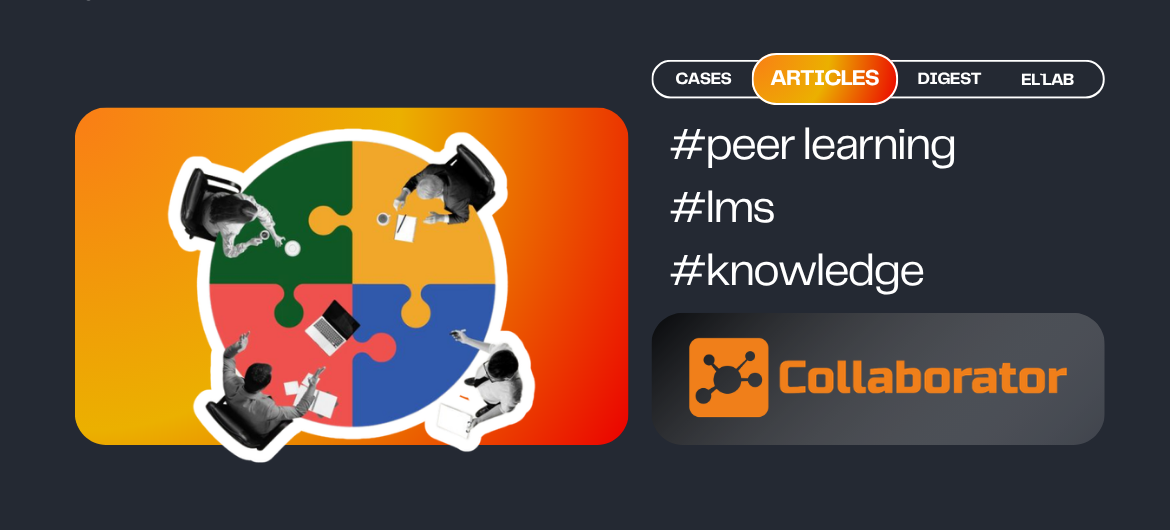
If we set aside complex academic terminology, peer learning is an approach in which employees learn from the real-life, day-to-day experiences of their colleagues.
The L&D team no longer needs to create cumbersome courses for every specific business request. For example, a newcomer to the sales department can simply watch a 10-minute video breakdown of a successful deal by a top salesperson. It’s quick, targeted, and 100% tailored to your company’s reality.
How does this change the role of L&D? You shed the burden of being the “sole content creator” and become an architect of the learning environment.
In this model, the L&D specialist focuses on strategic facilitation: they engage internal experts with key expertise, help them highlight valuable insights for the entire company, and offer simple formats for rapid knowledge sharing without a complex methodological burden. At the same time, L&D builds a user-friendly infrastructure where any information can be easily recorded, instantly found, and immediately applied on the job. You create transparent ground rules and a user-friendly ecosystem. As a result, knowledge sharing becomes a natural part of the corporate culture, and the L&D department frees up time for large-scale strategic projects.
4 steps to launch peer learning in your company
To ensure that knowledge sharing doesn’t turn into uncontrolled chaos but actually works without your constant intervention, it’s worth setting it up systematically.
Step 1. Identify the individuals with key expertise
Talk to department heads or conduct a brief survey within teams: Who do new hires turn to most often for advice? Who regularly comes up with creative solutions? Invite these people to become in-house experts. For many, this is a great way to gain recognition and develop their soft skills.
Step 2. Offer the simplest possible formats
Don’t expect practitioners to develop complex courses with quizzes. After all, they don’t have time for that. Rely on user-generated content:
- A 10-minute interview with answers to frequently asked questions;
- a short screencast (screen recording) demonstrating how to use a specific service or spreadsheet;
- a checklist or step-by-step guide for a typical work situation.
Step 3. Centralize and organize your materials
Even the most valuable content is wasted if it gets lost in messenger chats or private folders on personal drives. To create effective peer learning, you need a single, convenient hub for knowledge.
LMS Collaborator features a Knowledge Base designed for this purpose. It is a comprehensive environment for organizing all corporate expertise: content can be easily grouped by category, tagged, configured with flexible access rights for different departments or roles, and quickly updated.
What’s more, with the release of the LMS Collaborator 3.0 update, AI features — including smart search — have been added to the platform. It helps you find materials in the Knowledge Base not by exact word matches, but based on the meaning of your query. Thanks to semantic analysis, the system understands the context and meaning of a phrase, even if you made a mistake in your wording or can’t remember the exact title of the document.

Step 4. Incorporate this knowledge into your daily work
For the materials you save to be of real benefit to your business, you should link them to practical tasks.
Integrate these materials from the Knowledge Base directly into onboarding pathways for new hires, or use them to create regular learning assignments in the LMS. Thanks to this automation, new hires have access to their colleagues’ proven expertise from day one, and internal experts no longer have to spend their time giving repetitive verbal explanations.
OLEKSANDR Shatkivskyi – E-Learning Director at SoftServe Inc
But it gradually became clear that the professional production model has its limitations. At one of the international conferences, we heard Facebook share that 9 out of 10 videos are created not by professional studios, but by ordinary users. And it is precisely this lively, authentic, and not always perfectly polished way of conveying information that, in many cases, works even better.
We were inspired by this concept and implemented it within the company in the form of UGC (User-Generated Content). Instead of bringing in an expert for every stage of the production process, we began providing them with recommendations on how to create short, effective videos, audio podcasts, informative presentations, a library of infographics, templates, and tools for creating content independently using corporate resources.This became particularly important when we realized that, even with an optimistic budget, a professional e-learning team would physically be unable to handle all content creation requests across all business areas to a high standard. UGC allowed us to scale our expertise without proportionally increasing the size of the production team. And this is especially relevant given the combination of budget constraints and simultaneous global growth.
At the same time, for several years now, we’ve been seeing another significant step in this direction: AI self-services. An expert can independently create a video, individual training material, or even an entire course, experiment with formats, and quickly and iteratively improve the content. We wholeheartedly welcome such self-service approaches: experts gain more freedom and control over their own knowledge, while the professional e-learning team remains sharply focused on complex development projects as before.
That’s why today I’d like to talk about expert motivation in the context of building the right ecosystem for collaboration: a professional team is responsible for complex, strategic, and high-value educational solutions, while self-service and AI tools enable experts to share their knowledge quickly and independently.In this model, an expert does not become just another “content creator.” They remain an expert who is provided with a simple way to share their expertise. And the educational team scales not the number of courses produced, but the impact of learning on the business.
Conclusions
The maturity of a corporate learning system is measured by whether employees continue to develop and share their experiences when the L&D manager goes on vacation.
Peer learning is a method for turning a team’s experience into a key business asset. When knowledge flows freely among colleagues, the company becomes more flexible, new hires adapt more quickly, and the L&D department can finally focus on the strategic development of its people.
All you need to get started is to provide this culture with a user-friendly digital environment where information chaos is transformed into a structured and accessible knowledge base.
If you want to build such an ecosystem in your company, submit a request for access to the LMS Collaborator trial portal. We’ll grant you access and show you how to organize your knowledge base, enable AI search, and launch knowledge sharing without unnecessary red tape.