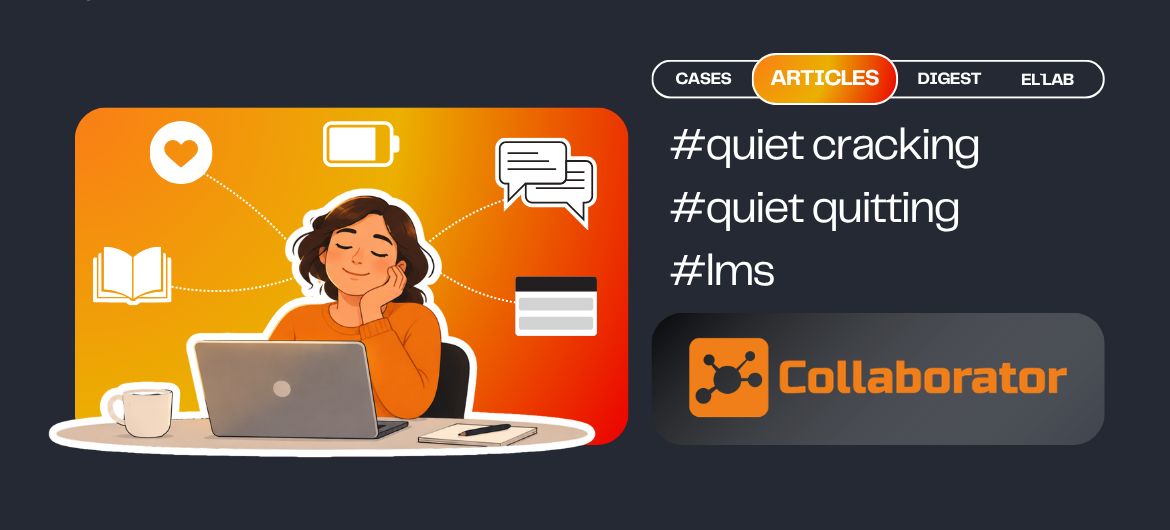
Between resignation and burnout: How an LMS helps prevent “quiet cracking” in a company
The modern labor market has been in a state of constant turbulence for several years now. Remote work, hybrid work models, the fast pace of business, and general background stress have created conditions under which traditional approaches to employee engagement no longer work as they used to. According to Gallup’s “State of the Global Workplace 2024” report, about 41% of employees worldwide experience significant levels of stress every day. In the past, the signs of burnout were clear and visible from a distance: an employee would start conflicts, consistently miss deadlines, or openly ignore tasks. Today, however, the situation has changed. Hidden stress forces people to adapt to burnout in a completely different way, hiding their true feelings behind a facade of productivity.
That is precisely why standard burnout analytics are no longer enough for HR professionals and managers. Two insidious phenomena have replaced overtly destructive behavior: the well-known “Quiet Quitting” and a relatively new but extremely dangerous trend — “Quiet Cracking.” In this article, we’ll discuss the main symptoms, how to identify them, and what preventive measures can help you avoid these trends from taking hold in your team.
Quiet Quitting vs. Quiet Cracking: What’s the difference and how to recognize the stages of burnout
Both terms describe a state of internal withdrawal from engagement, but they represent different stages and require different responses.
Quiet quitting is a behavioral strategy: a person consciously limits their contribution to their formal duties. “I do exactly what I’m paid to do—and nothing more.” No one notices anything amiss, but performance metrics decline gradually and noticeably.
Quiet cracking is a condition that is often masked by the opposite behavior: a person continues to work at the limit of their capabilities — sometimes even at 120% — because they’re afraid of letting the team down, losing their position, or appearing “not good enough.” There is no visible drop in productivity here; instead, there is perfectionism, hidden exhaustion, and anxiety that eat away at a person from the inside, while on the outside everything looks flawless.
A study by TalentLMS confirms the scale of the problem: 54% of employees experience “quiet cracking” in one way or another, with 20% experiencing it constantly or frequently. An even more telling detail is the gap between current and future confidence: 82% of employees feel secure in their current position, but only 62% are confident about their future with the company. This is the 20% gap where “quiet cracking” takes root. The problem is that this gap is nearly impossible to detect through standard performance metrics. An employee experiencing “quiet cracking” continues to deliver results. Therefore, it’s important to look not at metrics, but at behavioral patterns.
Checklist: How to spot a problem before it turns into a crisis
Since an employee in a state of “Quiet Cracking” continues to deliver high KPIs, traditional task-tracking methods are ineffective in this case. It’s important to pay attention to behavioral indicators and changes in usual patterns.
Here are a few subtle signs that indicate a person is on the verge of burnout:
- Excessive hyperactivity outside of work hours. If a colleague starts consistently responding to chat messages at 11:00 p.m. or submitting completed assignments at 6:00 a.m., this isn’t always a sign of high motivation. More often than not, it’s a sign of a loss of control over the workday and an attempt to compensate for anxiety by sacrificing rest.
- Emotional detachment from informal social interactions. The person continues to respond clearly to work-related questions but completely ignores coffee breaks or informal company chats. The level of empathy in communication decreases.
- Hypersensitivity to constructive feedback. When one’s inner reserves are depleted, even the slightest work-related comment is perceived as a personal disaster or confirmation of one’s own lack of professionalism.
But how can you assess the state of a team when an organization has dozens or hundreds of employees? Identifying such symptoms manually is nearly impossible. And this is exactly where a properly configured automation and corporate training system comes to the rescue of the HR department.
The role of an LMS in solving the problem
It’s important to dispel a common misconception right away: an LMS does not replace effective management. However, a modern LMS (Learning Management System) has long since evolved beyond being merely a tool for testing knowledge or ensuring compliance. It is a convenient platform for interaction, assessment, and creating a supportive environment. Thanks to an LMS, a company can implement a systematic approach to preventing burnout on multiple levels.
The right content in a convenient format
Long lectures on “stress management” can actually become an additional burden for someone who is already exhausted. The opposite principle applies here: microlearning — short, 5- to 10-minute modules on time management, emotional resilience, coping with anxiety, and work-life balance.
Regular feedback
In addition to the annual engagement survey, which may identify a problem long after it has arisen, an LMS also allows you to incorporate short, regular surveys directly into the learning process. For example, in LMS Collaborator, such surveys can be configured as part of the regular learning path, rather than as a separate program. This makes it possible to track changes in morale in real time, rather than having to guess about them after the fact.

Example of a survey in LMS Collaborator
Social learning and a safe space
Forums, course comments, and group online activities aren’t just secondary features of an LMS — they’re a way to turn learning into a space for sharing real-world experiences, rather than just acquiring knowledge. When people see that their colleagues are also facing similar challenges, this in itself reduces the sense of isolation that fuels quiet burnout.
Communication in the LMS Collaborator forum
Support through announcements and reminders
Employees experiencing “Quiet Cracking” often lose track of time and are constantly in “catch-up” mode. At such moments, they need a gentle external cue to break the cycle.
The LMS’s built-in communication tools allow you to systematically check in on your team’s well-being without adding extra psychological pressure. For example, on LMS Collaborator’s home page, you can post short reminders: from tips on shifting focus and breathing techniques to prompts to wrap up the workday on time. These regular messages serve as gentle reminders. They are what foster a culture where taking care of one’s own well-being is a normal part of the work process, rather than a sign of weakness.
Simple announcements in LMS Collaborator
Training for managers
This is perhaps the most important and, at the same time, the most frequently overlooked element. Team leads are the first line of defense who could spot signs of burnout long before an employee resigns, but they often lack both the time and the skills to do so. With an LMS, you can quickly roll out short, practical modules for team leads. These modules will teach managers to strike a balance: to recognize early signs of burnout in their team members, conduct genuine one-on-one meetings, and address issues without overstepping personal boundaries. This helps fill a gap in management where, previously, managers had to rely solely on their own intuition.
Common mistakes made by companies
- A one-time training session instead of a systematic approach. A single webinar on stress management once a year doesn’t change behavior patterns — consistency is key.
- Reacting only to a formal resignation. Until a resignation letter is on the desk, the problem is considered nonexistent, even though a quiet breakdown has been developing for months leading up to that moment.
- Learning without feedback. Content is published, but no one checks whether it meets the team’s actual needs or is even helpful at all.
- Placing the responsibility solely on HR. Without involving direct managers, no initiative works — it’s the team lead who sees the team every day, not just once a quarter.
Conclusions
The emotional resilience of a team is gradually becoming just as measurable an indicator as productivity or employee turnover. The only question is whether the company has a system in place that regularly gathers this data and provides managers with a tool for taking action, or whether everything continues to rely on the vigilance of individual managers, who are themselves exhausted right now.