Formal learning usually looks rather mundane: a lecture plays in a muted background tab, slides are skimmed between urgent work tasks, and the correct answers to a test have already been circulating in a group chat among colleagues for the past half hour.
The paradox is that this very ingenuity is what makes the final report look flawless: the pass rate is impeccable, and every test has been passed. Yet because the learning material stays parked in a background browser tab, people continue to work the way they always have. The company has spent resources and met its formal metrics, but has seen no change in how tasks are actually done.
Attempts to change this situation through administrative pressure only push the problem deeper: staff members rush through tests just to get them out of the way. Genuine motivation to learn emerges when an employee clearly understands that specific material will help them complete tasks faster, make fewer mistakes, or earn more money.
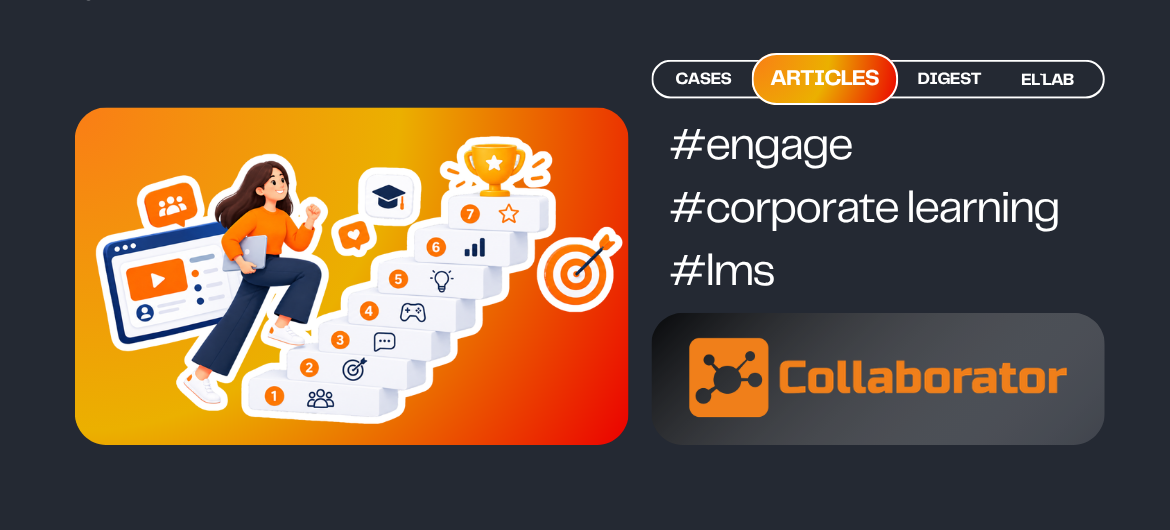
In this article, we explore seven practical steps that can help your L&D team build a learning environment people choose to engage with voluntarily.
Step 1. Start from a Business Problem, Not from a Course Topic
No adult professional wakes up with a burning desire to take the “Time Management and Effective Communication Course 2.0.” Instead, they are grappling with urgent daily challenges: a client cancels an order, a production line breaks down, or a new policy for processing product returns at the checkout is written in such complex language that it’s easier to just ask a colleague. Therefore, the primary task of a corporate learning specialist is to identify these pain points and uncover the underlying business problem.
“What course to create?”
“What specific operational activity is currently being performed incorrectly or consuming too many resources?”
Practical example:
Instead of a 40-minute theoretical course on “B2B Negotiation Standards,” create a 7-minute breakdown of a real-life scenario: “How to respond when a client demands a 20% discount and threatens to switch to a competitor.” When learning addresses a specific, painful challenge that employees face at work, they don’t need reminders: they’ll open the material themselves to make their lives easier right away.
Step 2. Find a Business Stakeholder and Make Them the Face of the Program
If HR or L&D is the sole initiator of a learning project, line departments tend to view it as yet another abstract burden imposed from above.
To shift this perception, identify a department leader who is struggling to hit a specific business metric and bring them on board as an internal sponsor of the program:
Identify a key stakeholder: For example, it may be a service department manager whose team is struggling with slow request processing, or a commercial director whose team is underperforming at the upselling stage.
Turn this manager into the learning program ambassador: A short video message from them at the start of a module will be far more effective than dozens of standard automated emails. Employees need to hear that their specific pain points are being addressed. For instance: “We’ve analyzed the top five mistakes that cost us our clients this quarter. Here is a step-by-step plan to avoid them.”
Align the learning with frontline management: If a team lead doesn’t ask during weekly meetings which new tools the team has tried, the value of the program could be undermined.

Step 3. In-the-Flow-of-Work Learning
Imagine a bookstore sales associate. A customer is waiting at the checkout, a line is forming behind them, and the system displays an unfamiliar error. Will the employee take that moment to search for a 60-page policy document in the corporate database? Of course not. They will most likely panic or call a shift supervisor.
The framework developed by Bob Mosher and Conrad Gottfredson identifies five moments of learning need: New, More, Apply, Solve, and Change. Traditional corporate learning almost always focuses on the first two, overloading people with theory in advance. However, real engagement occurs at the Apply and Solve moments, right in the flow of work.
Convert some of your learning content into formats designed for on-the-job support:
Concise checklists: outlining the sequence of steps to follow before starting up equipment.
Quick-reference guides: for navigating the system or processing a non-standard order.
60- to 90-second videos: demonstrating a single specific action that can be viewed on a smartphone or at a workstation.
When employees know that the learning resource provides the answers they need within half a minute, without unnecessary fluff, they develop the habit of returning to it.
Step 4. Seamless UX in LMS
Modern users are accustomed to the seamless interfaces of streaming services, banking apps, and social networks. If accessing a company’s internal content requires remembering a login, getting through three layers of authentication over a slow VPN, and then trying to read a desktop-formatted PDF table on a phone screen, engagement vanishes.
Every unnecessary barrier in the digital environment makes it less likely that an employee will reach the content at all.
What does a seamless experience look like in practice?
Mobile-first access: For frontline staff, production workers, or retail floor employees, a smartphone is often the primary work tool. Content must adapt to the screen automatically, without friction or manual adjustments.
Hassle-free authentication: Integration with corporate single sign-on (SSO), login through work messaging apps, or one-click access with an existing system account.
Google-like search: The ability to find a document by keyword rather than digging through a complex folder tree full of names like “Regulations_2023_Final”.
The LMS Collaborator web platform is designed specifically to eliminate unnecessary friction. Employees can reach the task or knowledge base they need in just one or two clicks. The mobile version runs reliably, and users can even set up fingerprint or Face ID login on their smartphones.
Step 5. Activate Internal Learning Marketing
Many valuable internal projects fail simply because no one told anyone about them. The L&D team might spend weeks developing the structure, coordinating with subject matter experts, and curating content, yet at launch employees may see nothing more than a dry, automated email: “You have been assigned Task #142. Deadline: 10 days.”
Treat your colleagues as internal clients. If you want them to invest their time and attention, sell them on the value of the initiative.
Use the LMS Collaborator news portal to launch internal promotional campaigns. Share authentic testimonials, publish digests of practical tips from in-house experts, and highlight employee success stories. Trust in recommendations from colleagues is usually higher than in directives issued by the central office.
Step 6. Measure Engagement through Results
Unfortunately, a high completion rate does not guarantee that employees will actually apply what they learn on the job. Focusing reports solely on completion percentages can reduce learning to a mere formality. Shift the focus of engagement measurement from the process to the outcome:
Time-to-proficiency: How many days does it take a new employee who has completed an onboarding track to start serving clients independently and effectively, or to meet performance targets? If this time drops from three weeks to ten days, the learning is working.
Organic demand for the knowledge base: How often do employees return to the materials on their own, without reminders or mandatory assignments? If a checklist is accessed dozens of times a month directly from the workplace, that is the best proof of its usefulness.
Operational metrics: Has the number of errors in CRM order entry decreased? Has the rate of product returns dropped since a guide on verifying order contents was introduced?
When employees see that this knowledge helps them finish their tasks faster, avoid conflicts with clients, or meet the KPIs required to earn a bonus, their mindset shifts to: “It is in my own interest to learn.”
Step 7. Create a Focus Group for Continuous Feedback
To avoid working in a vacuum, transform your employees from passive consumers into co-creators of the learning environment:
Assemble a focus group: Invite five to seven active practitioners from different areas, for example, a strong mentor from the sales floor, an experienced engineer, or a support team lead. Participation doesn’t have to be limited to top management, as frontline employees often offer the most valuable perspectives.
Hold regular, brief retrospectives: Meet for 45 minutes once a quarter to discuss candidly which materials are outdated, which parts of the latest course proved impractical, and what information newcomers lack during their first week.
Test hypotheses before a full-scale rollout: Show a new module or checklist to your focus group first. In just ten minutes, they can point out where you may have overlooked real-world work scenarios.
When people feel that their voices influence company processes, they stop resisting learning and become its strongest advocates among their colleagues.
Conclusion
True engagement in corporate learning doesn’t happen the moment you add badges or introduce penalties for overdue tests. It is the natural outcome of a system that respects employees’ time and understands the realities of their daily work.
Want to explore how to build a user-friendly learning environment, free from overload and unnecessary busywork? Request a demo of LMS Collaborator. We’ll show you how to tailor the platform to your teams’ workflows, set up mobile-friendly microlearning, and get real-world analytics on staff engagement.