How to automate employee onboarding using LMS Collaborator
According to research by the Brandon Hall Group, effective onboarding can increase employee retention by 82% and productivity by more than 70%. At the same time, up to 25% of new hires leave the company within the first six months.
Chaotic onboarding always leads to losses. Manual processes, an overburdened HR department, and situations where new hires are forced to search for information on their own—all of these slow down the onboarding process and increase business costs. Some employees never reach full productivity, while others leave the company altogether.
And the faster the team grows, the more obvious it becomes: without a systematic approach, onboarding becomes difficult to scale and manage. Automation helps solve this problem.
Why traditional onboarding is gradually becoming obsolete
The traditional approach to onboarding was developed back when teams were small. Back then, everything could be done manually: handing over documents in person, giving the new hire a tour of the office, and explaining processes through face-to-face conversation.
Today, the landscape has changed. Companies are growing faster, and hiring happens on a regular basis. On top of that, teams are often geographically dispersed. In this context, manual onboarding is increasingly unable to keep up with the demand
- HR is constantly answering the same questions,
- managers spend time explaining the basics,
- and employees themselves don’t always understand exactly what is expected of them.
Some information is lost, while other information is put off “until later.” As a result, the adaptation process is delayed and ends up costing the business more than it should.
What does onboarding automation mean?
Onboarding automation is when the system takes care of the routine tasks
- schedules learning,
- sends reminders,
- monitors progress,
- and tracks completion.
This allows HR to focus on people rather than paperwork.
Automation doesn’t make onboarding impersonal. On the contrary, it leaves room for what really matters: support, feedback, and face-to-face communication.
How do LMS Collaborator tools automate onboarding?
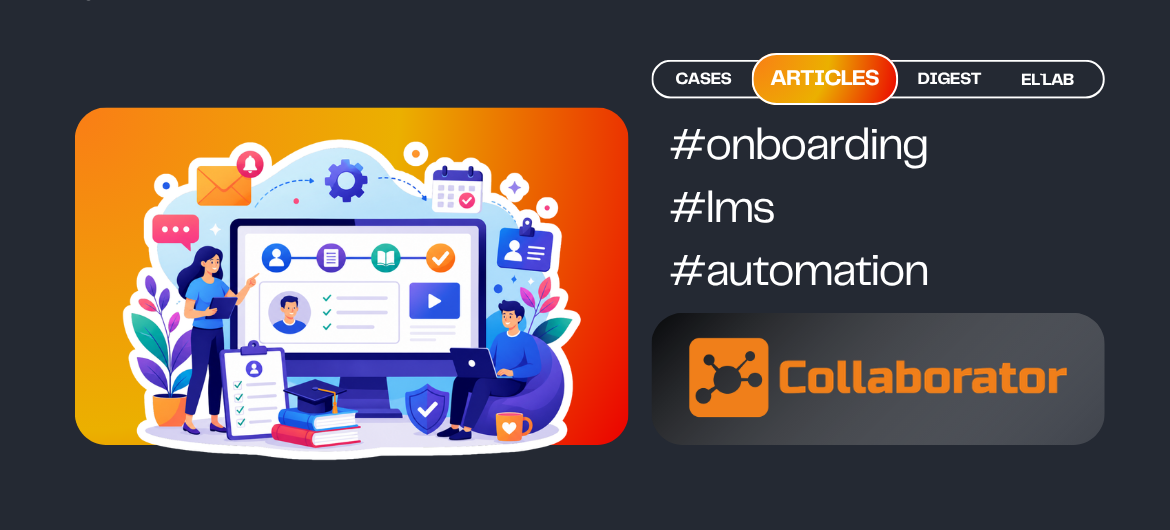
LMS Collaborator allows you to structure onboarding as a step-by-step, guided process—from day one through the end of the probationary period.
Automatic assignment.
When a new employee joins the system, a preconfigured onboarding path is automatically initiated for them. They immediately gain access to the welcome course, required materials, internal guidelines, and their first assignments. This helps establish a clear onboarding process and eliminates the need for manual intervention.
Unified knowledge base.
All important information is gathered in one place: company structure, products, internal processes, policies, and procedures. New employees don’t need to search for answers in chat rooms or documents, or ask colleagues basic questions. The information is presented in a structured and easy-to-understand format, which helps them adapt to their work more quickly.

Checklists and task setting.
The initial stages of onboarding can be organized using checklists. Employees see a clear plan of action for their first few days or weeks, while managers and HR can track progress. This approach helps structure the process and make it clear to everyone involved.
Automatic reminders and notifications.
The system automatically reminds users of unfinished tasks or missed steps. This reduces the need for manual oversight and helps maintain a steady pace of onboarding without additional intervention from HR.
Analytics and progress monitoring
HR and managers can check at any time how an employee’s onboarding is progressing: which stages have already been completed, where delays are occurring, and who needs additional support. This makes onboarding more transparent and manageable.
As a result, a clear and manageable system replaces the chaotic process, one that operates without constant manual intervention.
Why should companies automate their onboarding processes?
Automating onboarding delivers tangible results right from the start:
- New hires settle into their roles more quickly and start working more effectively, as they have a clear onboarding plan, access to all necessary materials, and a clear understanding of their responsibilities from day one.
- The process becomes more structured and predictable: the number of mistakes and instances of lost information decreases.
- The HR team frees up time from routine processes and can focus more on supporting employees, developing corporate culture, and retaining talent.
- Managers spend less time repeating basic information to each new hire, as the system handles a significant portion of the onboarding process.
And most importantly, onboarding becomes a unified and scalable process. Regardless of the number of new employees, the company ensures a consistently high-quality onboarding experience for everyone.
Conclusion
Onboarding automation involves creating a streamlined system that helps new employees adapt more quickly and enables businesses to use their time and resources more efficiently.
The sooner a company transitions from manual onboarding to a systematic approach, the easier it is to scale the onboarding process, maintain consistent standards, and reduce the workload on HR and managers.
LMS Collaborator helps you set up this process once. After that, the system manages it automatically: it assigns learning, tracks progress, sends reminders about important milestones, and provides transparent monitoring of onboarding.
If you want to see how it works in practice, try LMS Collaborator.